
Sustainable Finance in the Insurance Industry?
This article is only available in German.

Now that we are in 2020, time is pressing more than ever, as the wealth of studies on climate change prompts greater public engagement with its consequences. We all understand the challenges posed by global warming. Sustainable finance in the insurance industry is no exception. On the one hand, insurers feel the effects of climate change as providers of risk protection; on the other, they are among the world's largest institutional investors. In these two roles, they can actively reduce CO2 emissions through their investments. The greatest challenge in this task is to define sustainability risks meaningfully. This is the responsibility of risk management teams and/or actuaries.
What constitutes a sustainability risk? In general, these are events relating to environmental, social or governance issues that may adversely affect a company's assets, financial position, profitability and reputation. The acronym ESG stands for Environmental, Social and Governance. The standard ESG risk categories take the form of physical risks and transition risks. Physical risks arise both from individual extreme weather events and from long-term changes in climatic and environmental conditions (e.g. storms, hail and wildfires). Transition risks arise from the transition to a low-carbon economy through policy measures, the use of new technologies or changes in consumer behaviour. Potential financial impacts include changes in demand for products and services, production, resources and pricing.
Under a two-stage approach, the impact of an ESG risk on business activities is measured and assigned to one of the existing categories.
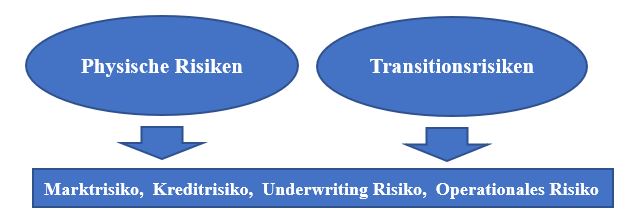
Example of ESG risk allocation:

What measures can institutional investors take to minimise these risks?
- Screening: Excluding sectors with elevated ESG risk (blacklisting);
- Best-in-Class Investment: A form of ‘inclusive’ screening. Investors purchase securities from issuers that meet ESG criteria;
- Divestment: Selling or reducing portfolio holdings in particular sectors or industries that do not meet ESG criteria;
- Engagement: An alternative to divestment: using shareholder rights (e.g. voting rights) to influence issuers' strategies;
- Thematic Investment: Increasing portfolio holdings in particular sectors or industries that align particularly well with ESG criteria;
- General ESG Integration: Explicitly considering ESG risks in the selection process.
Among the most effective tools for identifying sustainability risks are scenario analyses, stress tests, carbon footprint disclosure and management, and the active use of ESG ratings.
Actuaries, in particular, can draw on their expertise to incorporate multiple disciplines into their assessment of climate risks. This requires standardised corporate reporting requirements and scientific studies, with data quality playing a crucial role in the process of improving models.
The growing importance of ESG criteria is a trend that will affect not only investors but all business owners in the coming years. Everyone has a responsibility to assess these criteria correctly and make sustainable decisions.
Tetyana Kohansal