Ada Lovelace: The First Computer Programme
This article is only available in German.
…following in the footsteps of an IT pioneer
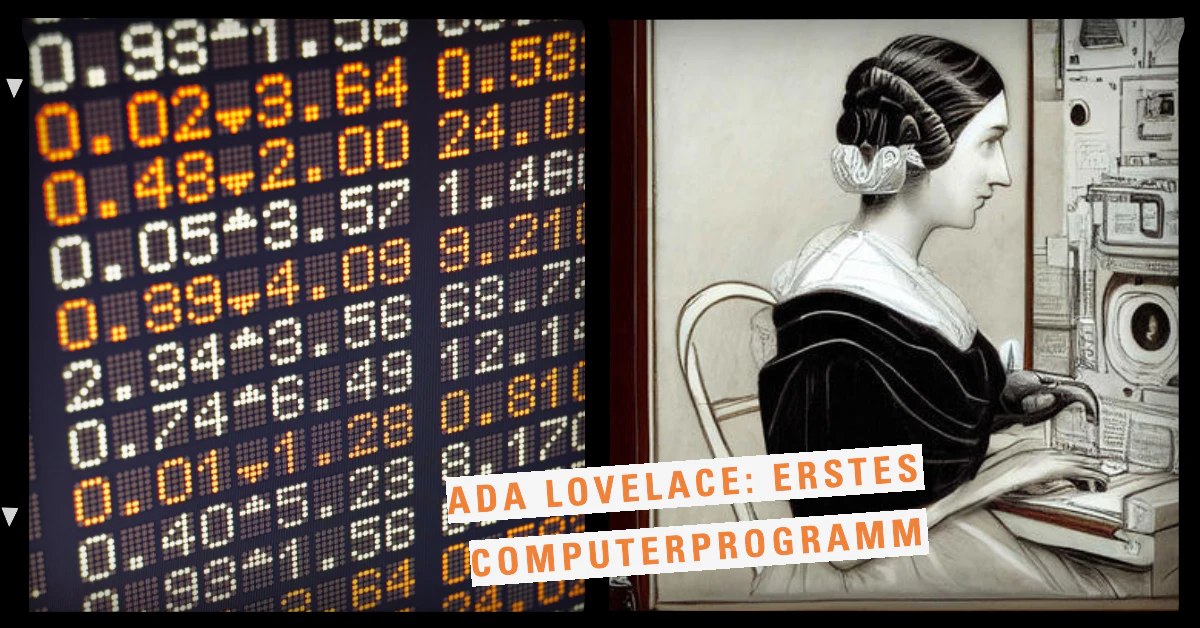
The IT industry remains male-dominated to this day. Yet some 160 years ago, a woman carried out important pioneering work! Ada Lovelace, a British mathematician, developed an algorithm that went down in history as the world's first computer programme.
The life of Ada Lovelace
Ada Lovelace was born in 1815, the daughter of the famous poet Lord Byron. Her parents separated shortly after her birth. Her mother gave Ada a very strict and highly disciplined upbringing. Mathematics provided her with a subject she could explore even while confined to bed through illness. Her husband, William King, who later became the Earl of Lovelace, joined the Royal Society on her behalf, giving her access to libraries that would otherwise have remained closed to her.
Discovering the “Analytical Engine”
Her acquaintance with the mathematician and inventor Charles Babbage, who had invented the “Analytical Engine” – a mechanical calculating machine comprising thousands of precision gears – brought her fame and recognition. Ada was fascinated by this machine and its potential applications. The enormous apparatus was controlled using punched cards, originally invented to produce intricate patterns on semi-automatic looms. These essentially form a code in which different combinations of holes or their absence represent on or off.
Ada Lovelace's visionary insights
Charles Babbage estimated that his machine would take just three minutes to multiply two 20-digit numbers. Ada Lovelace, however, looked far beyond this achievement. She recognised that such a machine could not only perform calculations or solve mathematical problems, but could, in principle, process any information, provided it could be expressed mathematically. Ada wrote extensive notes on Babbage's invention, which attracted considerable attention, at least after her death. She provided an algorithm for calculating Bernoulli numbers and recognised its enormous potential even then. Earlier calculating machines were either limited to fixed calculations or required the operations to be performed to be entered manually. Programming, by contrast, allows highly complex algorithms to be formulated and executed automatically on a computer.
Legacy and a tragic end
Ada's poor health did not improve over the years. As her condition deteriorated, she was treated with morphine, then a new medicine, and prescribed alcohol as a stimulant. This combination led to drug dependence on top of her illness. She died at just 36, probably of cancer.
Some researchers argue that Ada Lovelace should not be regarded as the first programmer. Doron Swade, a researcher specialising in Charles Babbage, explains that Babbage's personal records already contained “programmes” for the machine six to seven years before Lovelace's notes. He stresses, however, that this in no way diminishes Lovelace's importance or her contributions, as her independent understanding of the computer's capabilities and potential represented a far more significant contribution.
In 1980, the US Department of Defense named a programming language (Ada) in her honour. There is also the Lovelace Medal, awarded by the British Computer Society since 1998 to individuals working in computer science or those who have helped make IT more accessible to the public. Even a cryptocurrency – ADA Coins – and a street (“Ada-Lovelace-Straße”) in Seestadt Aspern were named after the mathematician.
Saskia Resch